
With the booming development of global infrastructure construction, the market demand for cement pipes in municipal drainage, water conservancy irrigation, road and bridge culverts, and residential supporting facilities continues to rise. As the core equipment determining cement pipe quality and production capacity, the selection of a suitable cement pipe making machine directly affects the production efficiency, product qualification rate, and long-term profitability of pipe manufacturing enterprises. Many buyers often face confusion when purchasing equipment: how to distinguish high-quality cement pipe making machines from inferior products? What model is suitable for their own production scenarios? How to extend equipment service life through scientific maintenance? This article will comprehensively analyze the key selection factors, typical application scenarios, and daily maintenance skills of cement pipe making machines to provide practical guidance for enterprise procurement and operation.
First of all, equipment selection must be based on actual production demands and application scenarios. Different engineering projects have completely different requirements for cement pipe specifications, strength, and performance, which directly determine the type and configuration of the required cement pipe making machine. For small and medium-sized pipe factories engaged in urban residential drainage, community sewage, and farmland irrigation projects, the production demand is mainly medium and small-diameter cement pipes (200mm-1200mm) with conventional strength requirements. In this scenario, a horizontal high-frequency vibration cement pipe making machine is the most cost-effective choice. It features low investment cost, simple operation, flexible mold replacement, and stable output, fully meeting the daily mass production needs of conventional pipes.
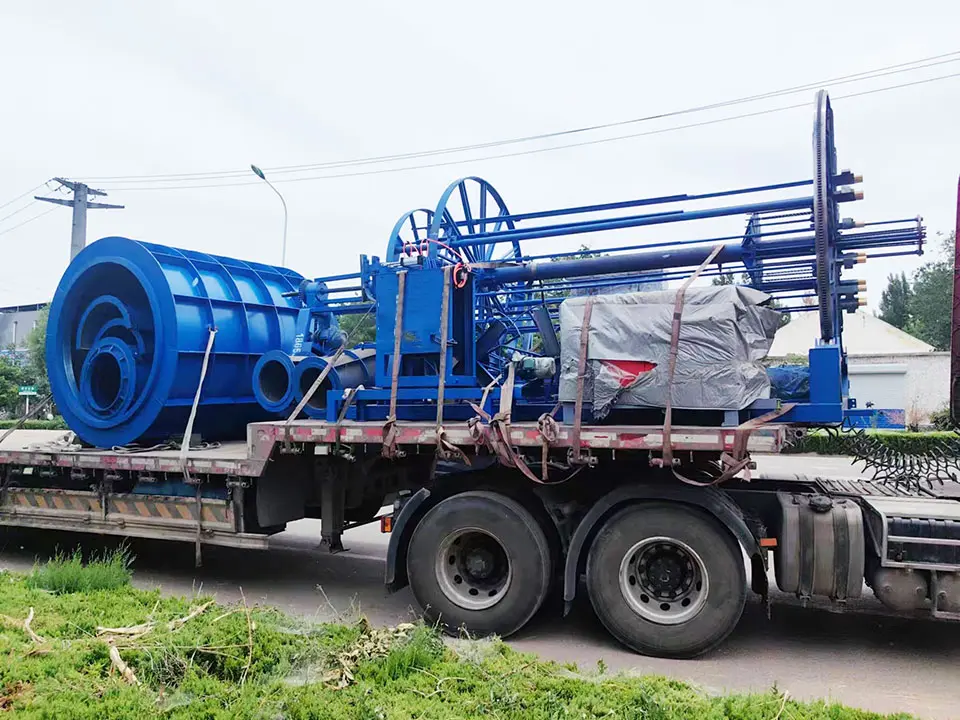
For large engineering enterprises and professional pipe factories undertaking highway, railway, bridge culvert, and municipal large-scale water conservancy projects, the production demand is mainly large-diameter, high-strength reinforced cement pipes (1200mm-2400mm) with strict seismic pressure resistance and anti-permeability requirements. In this case, a vertical automatic cement pipe making machine with high-power vibration system and reinforced mold structure is more suitable. This type of equipment has higher molding pressure and concrete density, and the finished pipes have stronger structural stability, which can adapt to harsh engineering environments such as deep burial and heavy load.
In addition, customized production scenarios also need targeted equipment selection. For projects requiring special interface pipes such as socket joints and tongue-and-groove joints, it is necessary to select a cement pipe making machine supporting customized mold development to ensure the tightness and installation accuracy of pipe assembly. For enterprises pursuing ultra-high production efficiency, fully automatic integrated equipment with automatic batching, feeding, molding, and cutting linkage system should be prioritized to realize unmanned continuous production.
Secondly, grasping core equipment performance parameters is the key to selecting high-quality cement pipe making machines. The first core parameter is the vibration system configuration, which determines the compactness and strength of finished pipes. High-quality equipment is equipped with an adjustable high-frequency vibration motor with a vibration frequency range of 2800-6000 times per minute, which can fully discharge air bubbles in concrete and improve pipe density. Inferior equipment usually has fixed low-frequency vibration, resulting in loose pipe walls, low strength, and easy water seepage.
The second key parameter is dimensional accuracy control. Excellent cement pipe making machines adopt advanced PLC intelligent control and frequency conversion speed regulation technology, with a fixed-length cutting error of less than 8mm, ensuring consistent pipe length and wall thickness. Precise dimensional control not only improves product qualification rate but also reduces assembly errors during engineering construction, saving overall project costs.
The third parameter is production efficiency and energy consumption. High-quality automated equipment has a production speed of 2-15m per minute, with a daily output of up to 100 standard pipes. At the same time, the optimized power system reduces idle energy consumption, realizing high efficiency and energy saving. When purchasing, buyers should avoid low-price and low-power equipment with slow production speed and high energy consumption, which will lead to long-term increased operating costs.
The fourth core parameter is mold quality and compatibility. The mold is the key component that determines pipe shape and precision. High-quality molds are made of thickened high-strength steel, with wear resistance and deformation resistance, and support multi-specification replacement. Equipment with strong mold compatibility can produce multiple types of pipes, greatly improving the equipment utilization rate and expanding the enterprise’s product market coverage.
Thirdly, manufacturer strength and after-sales service are important guarantees for long-term stable equipment operation. A reliable cement pipe making machine manufacturer has mature production technology, complete testing processes, and rich industry experience. Their equipment has undergone strict factory testing, with stable performance and low failure rate. In contrast, small workshop-style manufacturers often cut corners on materials and processes, resulting in short equipment service life and frequent failures.
In addition, perfect after-sales service is crucial. High-quality manufacturers provide one-stop services including equipment installation, commissioning, operator training, regular maintenance guidance, and spare parts supply. For industrial equipment with long-term continuous operation, timely after-sales support can effectively reduce downtime losses and ensure stable production progress. Buyers should prioritize manufacturers with complete after-sales systems and local service outlets when purchasing.
Scientific daily maintenance and operation management can effectively extend the service life of cement pipe making machines, reduce failure rates, and maintain stable production efficiency. First, do a good job in daily cleaning and lubrication. After daily production, clean the residual concrete on the mold, roller, and vibration system to prevent material condensation from affecting equipment precision. Regularly lubricate rotating bearings, transmission shafts, and other moving parts to reduce friction wear and avoid mechanical jitter and noise.
Second, regularly inspect core components. Regularly check the vibration motor, frequency converter, control system, and mold wear degree every week. If abnormal vibration, unstable speed, or mold deformation is found, adjust and repair it in time to avoid batch unqualified products caused by component failure. For wearing parts such as sealing rings and gaskets, replace them regularly according to the service cycle.
Third, standardize operation procedures. Operators must receive professional training before taking up their posts, strictly follow the equipment operation manual for batching, feeding, and parameter adjustment, and avoid overloading operation and random parameter modification. Overload operation will cause excessive wear of the motor and transmission system, and irregular parameter setting will affect the molding quality of cement pipes.
Fourth, do a good job in equipment storage and seasonal maintenance. When the equipment is shut down for a long time, clean and maintain it comprehensively, apply anti-rust oil on metal parts, and cover it with dust-proof equipment. In rainy and humid seasons, strengthen the inspection of circuit and electrical control systems to prevent short circuit and equipment damage caused by moisture.
In practical industrial applications, high-quality cement pipe making machines have created huge value for various industries. In municipal engineering, they provide high-quality drainage and sewage pipes, ensuring the smooth operation of urban underground pipe networks and solving urban waterlogging and sewage discharge problems. In agricultural water conservancy construction, standardized cement pipes are used for farmland irrigation and water delivery, improving agricultural water utilization efficiency. In traffic infrastructure, large-diameter cement culvert pipes produced by professional equipment are widely used in highway and railway roadbed drainage and culvert projects, ensuring traffic operation safety.
To sum up, selecting a suitable high-quality cement pipe making machine requires comprehensive consideration of production scenarios, equipment performance parameters, manufacturer strength, and after-sales service. Combined with scientific daily operation and maintenance, enterprises can maximize equipment production efficiency, stabilize product quality, and gain competitive advantages in the fierce market competition. With the continuous upgrading of infrastructure construction standards, intelligent, efficient, and energy-saving cement pipe making machines will become the mainstream choice of the industry, promoting the high-quality development of the global concrete prefabrication and infrastructure construction industry.